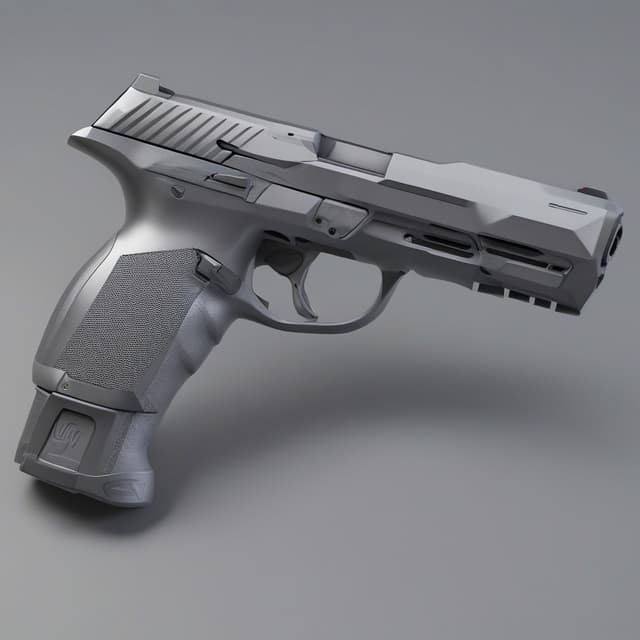
| Type | Smart pistol |
| Debates | Personal privacy • Public safety |
| Time period | Early 20th century |
| Civilian use | Limited |
| Key features | Biometric identification • Wireless controls • Precision targeting |
| Primary users | Military • Law enforcement |
| Technological development | Ongoing 'arms race' between criminals and manufacturers |
"Smart pistols" is the term used to describe a class of early 20th century handguns that incorporated advanced electronics and computerized components to provide enhanced functionality beyond traditional firearms. Emerging in the 1920s and 1930s, these innovative weapons utilized biometric identification, wireless controls, and precision targeting systems to increase accuracy, safety and security.
The origins of smart pistols can be traced to the rapid advances in electronics, materials science, and miniaturization technologies during the early 20th century. As electronic components like vacuum tubes and early transistors became smaller, cheaper and more reliable, engineers began exploring ways to integrate them into firearms.
Initial prototypes in the 1920s focused on using simple electronic circuits for features like magazine safety switches and grip-activated safeties. But by the 1930s, more sophisticated smart pistol designs began to emerge, incorporating components like:
These advanced features were enabled by rapid advancements in microelectronics and computer engineering during this period. Prominent early examples included the Colt M1911 Smart Pistol and Webley & Scott Smart Revolver models.
Smart pistols were quickly adopted by military and law enforcement organizations seeking to enhance the safety, security and accuracy of their sidearms. The biometric identification and wireless control features were particularly appealing for special forces and covert operations units, while the precision targeting helped improve marksmanship in combat.
Major militaries around the world, including the United States, United Kingdom, Soviet Union, and Imperial Japan, eagerly integrated smart pistols into their standard-issue equipment by the 1940s. Police departments in large cities also began equipping their officers with the latest smart pistol models.
The use of smart pistols in the field during World War II and other mid-20th century conflicts demonstrated their effectiveness, but also highlighted some limitations. Issues like electromagnetic pulses, hacking, and environmental interference could sometimes disable or compromise the electronic components.
While smart pistols were primarily used by military, law enforcement, and security personnel, the technology also saw some civilian adoption, particularly among wealthy private citizens and specialized users like private investigators and bodyguards. This raised concerns over the equitable access to such advanced weaponry.
Critics argued that smart pistols, with their emphasis on security and high costs, were effectively creating a "firearm elite" that could price out average citizens from handgun ownership. There were also worries that the biometric identification and wireless control features could be used to infringe on personal liberties and privacy.
Proponents countered that the enhanced safety and security features of smart pistols actually made them more suitable for civilian use, reducing accidents and misuse. But the controversies led to some restrictive legislation in certain jurisdictions, limiting access mainly to approved government and security personnel.
As microelectronics and computer technology continued advancing rapidly through the mid-to-late 20th century, smart pistols also went through successive generations of improvements and new innovations. Features like AI-assisted targeting, remote disabling, and even non-lethal stun capabilities were added.
However, the ongoing debate over privacy, security, and equitable access to advanced firearms persisted. Criminal elements also began developing countermeasures to bypass the security features, leading to an "arms race" between smart pistol manufacturers and hackers/modders.
Ultimately, smart pistols had a significant impact on crime, warfare, and society, changing the nature of personal defense and combat. While the technology remained controversial, it became an integral part of military, law enforcement, and (to a lesser degree) civilian firearms in the 20th century.
